
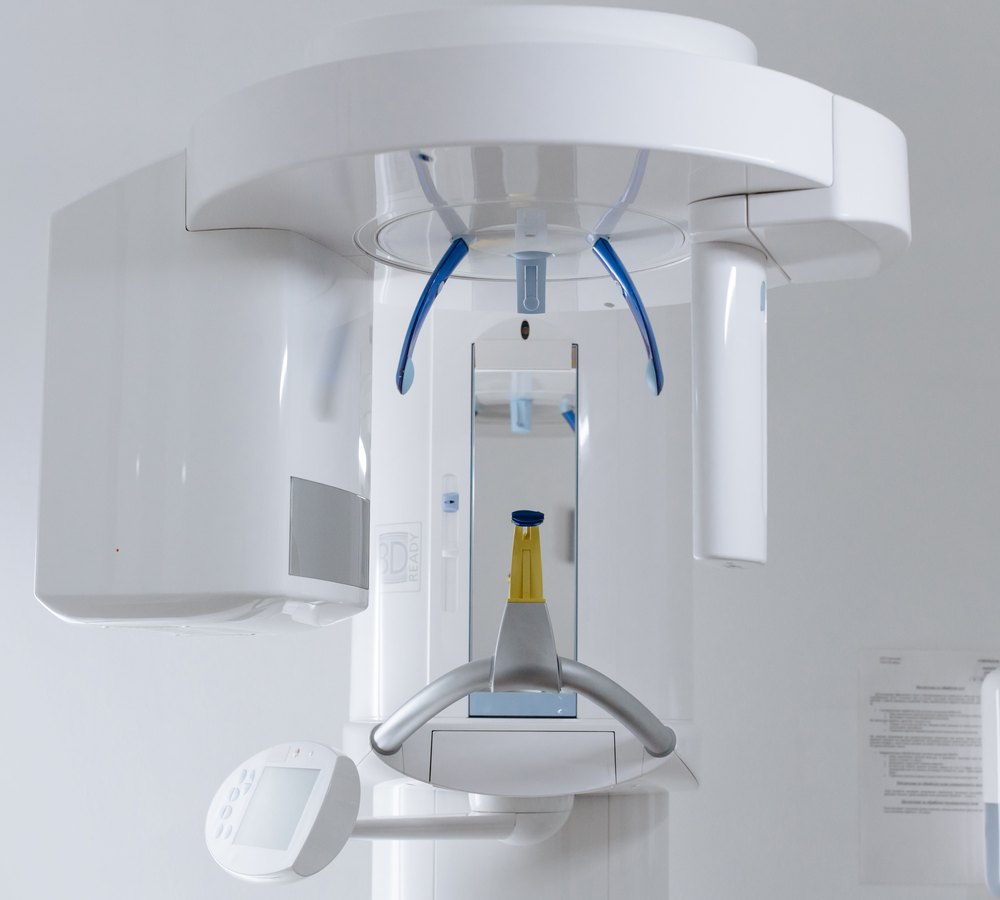
Cone Beam CT and 3D Imaging
Cone Beam CT is a fast 3D scan that shows the teeth, jaw, nerve pathways, and airway in about ten seconds, at a lower radiation dose than a medical CT scan. Dr. Arthur Johnson performs it at our Mission Viejo office for implant planning, extractions, and pathology, and accepts referrals from dentists and specialists who need a scan for their own patients.
Cone Beam CT, also called CBCT or 3D dental imaging, produces a three-dimensional view of the teeth, jawbone, sinuses, nerve pathways, and airway. A single scan takes about ten seconds and gives the surgeon far more information than a flat two-dimensional x-ray. The images can be rotated and measured from any angle, which supports accurate planning for implants, extractions, and other oral surgery. We offer it at our Mission Viejo and Covina offices, and every scan is stored digitally so it can be shared with a referring provider.
What a cone beam scan is used for
Cone Beam CT is used when a flat x-ray does not show enough. For dental implants, it measures bone volume and locates the nerve so the implant is placed safely. For impacted wisdom teeth, it shows how close a root sits to the nerve canal before extraction.
The same scan supports the evaluation of oral pathology, jaw and sinus anatomy, the TMJ, and the airway in sleep-related cases. Because the surgeon can measure directly from the 3D image, planning is based on the patient's real anatomy rather than an estimate.
For referring dentists and specialists
Dr. Johnson regularly performs cone beam scans at the Mission Viejo office for patients referred by other dentists, orthodontists, and oral surgeons. If your office does not have a CBCT unit, you can send a patient here for the scan and receive the images back for your own treatment planning.
Scans are captured quickly and returned in a standard digital format that opens in common planning software. To arrange a referral, call the Mission Viejo office and we will coordinate the appointment and get the images to you.
Did you know…
that the scan gets its name from the cone-shaped x-ray beam it uses to build the 3D image? It captures the full craniofacial area at a lower radiation dose than a conventional medical CT, and the file can be transferred between providers without repeating the scan.
Frequently Asked Questions
Does a cone beam scan hurt?
No. The scan is painless and non-invasive. You sit or stand still while the machine rotates around your head one time. There is no preparation beforehand and no aftercare.
How is a cone beam scan different from a regular dental x-ray?
A standard x-ray is a flat, two-dimensional image and shows mainly hard tissue. A cone beam scan is three-dimensional and shows bone, nerve pathways, sinuses, and soft-tissue relationships, which the surgeon can measure from any angle for treatment planning.
How much radiation does a cone beam scan use?
A cone beam scan uses a lower radiation dose than a medical CT scan of the same area. Your provider weighs the imaging against the clinical need before recommending it.
Can another dentist refer a patient for a cone beam scan?
Yes. Dr. Johnson accepts referrals from dentists and specialists who need a 3D scan for a patient. The Mission Viejo office captures the scan and returns the images for the referring provider to use in treatment planning. Call the office to arrange a referral.